Simulate before you execute
Rehearse pressure before release. Stress-test demand, fraud, edge cases, and escalation while the consequences are still synthetic.
A book by Jesper Lowgren
Agentic System Design is a field guide for the moment software stops merely executing instructions and begins sensing, deciding, learning, and cooperating under constraints.
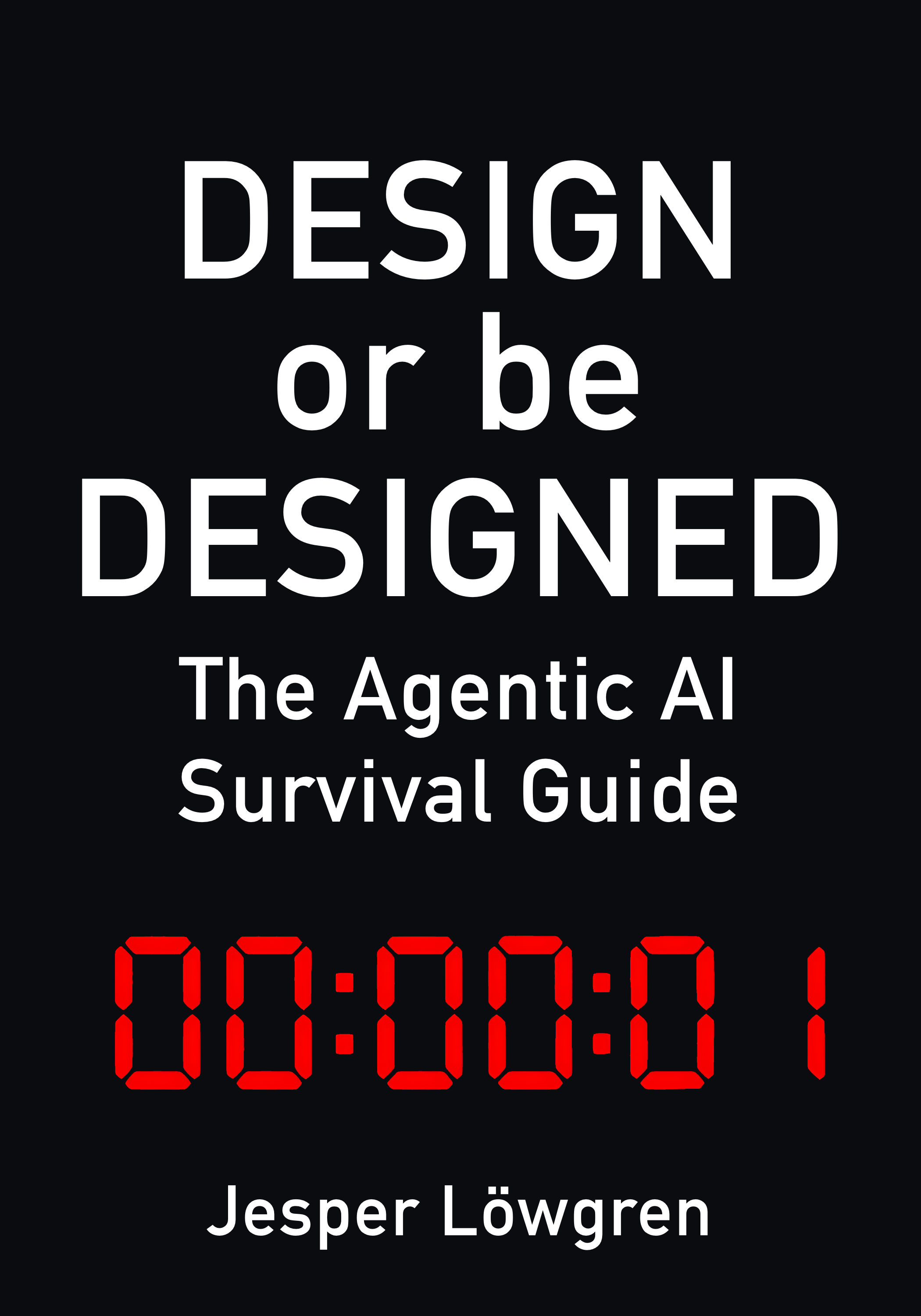
We have crossed a line. Software no longer waits.
Once intelligence can act, the design laws change.
This book is about those laws: how to shape agentic systems that perceive, decide, cooperate, and remain accountable as capability grows.
Most AI projects fail because they automate tasks without designing the conditions for autonomous behavior. They process data but do not bind meaning, policy, trust, and proof to action.
Agentic System Design reframes the work: from shipping features to shaping behavior, from isolated pilots to systems that improve under constraint, from retrospective governance to controls that run at the speed of the agents.
The core inversion
Traditional design starts with outcomes, specifies processes, and audits later. Agentic design begins inside the system: with boundaries, signals, policies, proof, and the conditions under which adaptation remains legitimate.
Five shifts
Rehearse pressure before release. Stress-test demand, fraud, edge cases, and escalation while the consequences are still synthetic.
Autonomous behavior cannot be fully scripted. Shape the rules, signals, incentives, and guardrails where acceptable outcomes can emerge.
Surprise is not a bug in agentic systems. Build modularity, provenance, redundancy, and thresholds that absorb it without collapse.
Granular oversight will not scale. Prepare kill switches, graceful degradation, reversible escalation, and policies that run.
Governance must happen as action unfolds: continuous provenance, live trust metrics, and distributed human intervention.
The system view
They need roles, passports, shared meaning, runtime controls, simulation evidence, human participation, and a data backbone strong enough to make every action traceable.
Nine roles give agents atomic scope: perceptual, verifier, analytical, planner, decision, executor, coordinator, advisory, and learner.
Every event carries identity, authority, provenance, confidence, policy bindings, and lifecycle evidence.
Agents wake only when signals, thresholds, readiness criteria, and autonomy boundaries align.
Policy-as-data moves governance from documents into runtime constraints, thresholds, and escalation logic.
Twelve chapters
Why autonomy turns design inside out.
The maturity logic behind agentic readiness.
How cognition becomes executable and accountable.
Role design for coherent multi-agent work.
Events, passports, provenance, trust, and shared meaning.
Signals, triggers, autonomy gates, and choreography.
Policy-as-data and runtime control.
Scenarios, sandboxes, failure, and rehearsal.
Beyond human-in-the-loop toward designed stewardship.
Resilience, culture, and failure modes at scale.
The full system in a concrete operating context.
Adaptive governance, learning loops, and the social contract.
Agentic readiness
The book treats readiness as a balance across capability, governance, trust, and human participation. Push one dimension too far ahead of the others and the system becomes brittle.
Who it is for
Design the reference models, operating patterns, and boundaries for agentic ecosystems.
Move from screens and journeys to conditions, signals, and participatory control surfaces.
Turn prototypes into traceable systems with role clarity, evaluation, provenance, and runtime policy.
Understand where control changes, where legitimacy comes from, and what readiness really requires.
The proposition
Agentic System Design is the starting point of the Agentic Trilogy: a practical, rigorous way to build intelligent systems that can explain themselves, adapt responsibly, and operate at machine speed without losing human judgment.